Friday, 23 March 2012

Tourism Scenario in India at a Glance – 2010


Last year I posted a blog suggesting that though there is a wide spread effort on part of Min. of Tourism, Government of India to attract foreign tourists, we need to put sincere effort to promote domestic tourism also. To corroborate the same thought, I have put a small analysis using the latest data on Indian tourism. Ministry of Tourism has published “India Tourism Statistics 2010″ last month. This includes tourism data pertained to 2010. This is a simple straight forward analysis to suggest that the strength of domestic tourists are so great that a proper strategy to boost it further might result into generating huge revenue as well as employment generation.


Fig 1 below shows growth rate of domestic and foreign tourists from the year 2001 till 2010. The campaign of Incredible India has significantly increased inbound tourism to India during the 2000s. The graph shows s huge spike, at about 30 per cent, during 2002 and somewhat declining trend growth with a turf during 2009 which was marred with global recession. However, the declining trend was more due to base effect rather than decline in number in foreign tourists. On the contrary, domestic tourists have shown an increase between 10 to 20 per cent through out this period. However, the growth rate of domestic tourists remained lower than the foreign tourists almost during the entire period. (Click on the Fig to view properly)
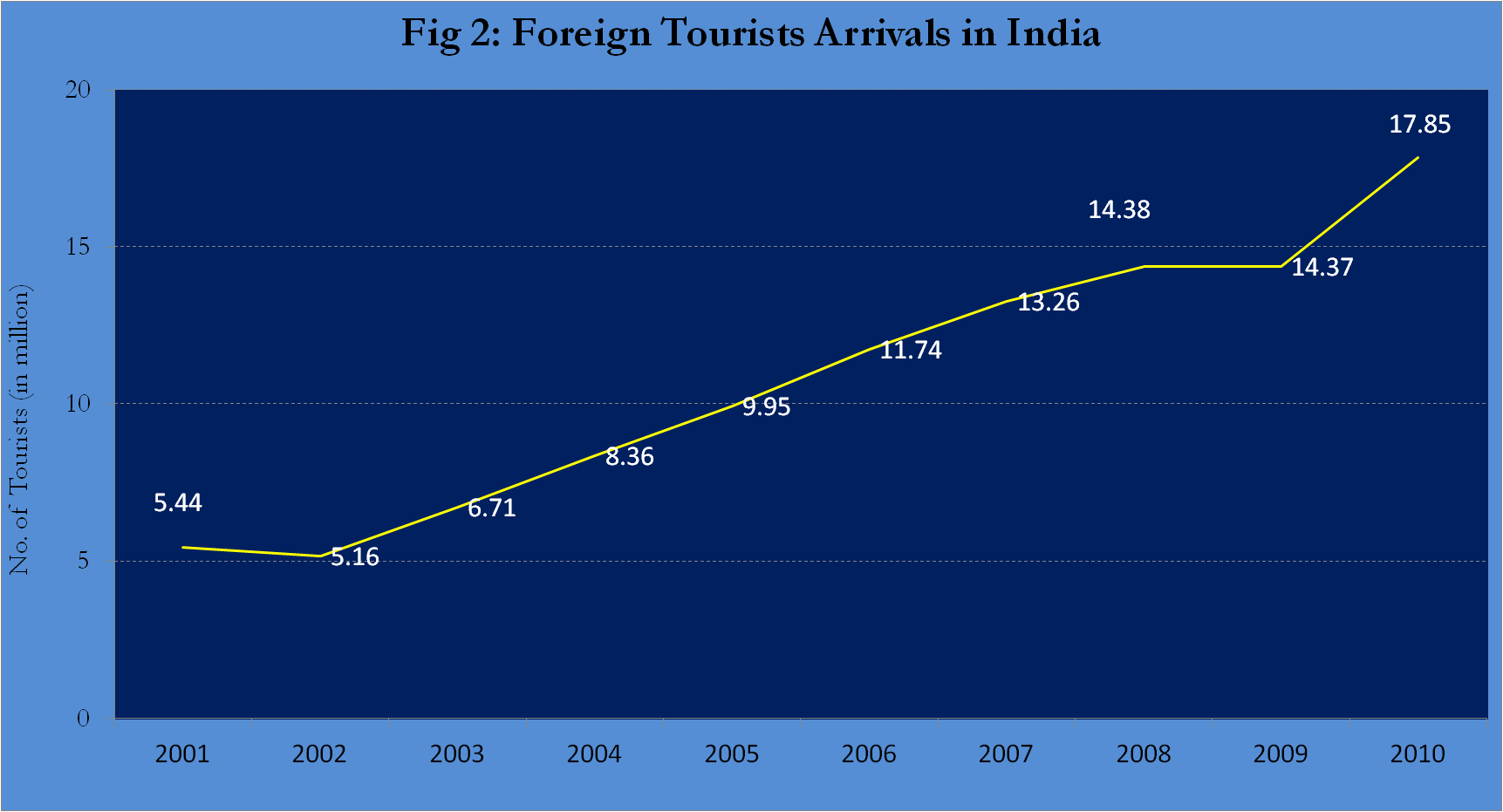
During the last decade, foreign tourist arrivals to India has increased from 5.5 million to about 18 million. Figure 2 presents the steady increase in number of foreign tourists. (Click on the Fig to view properly)
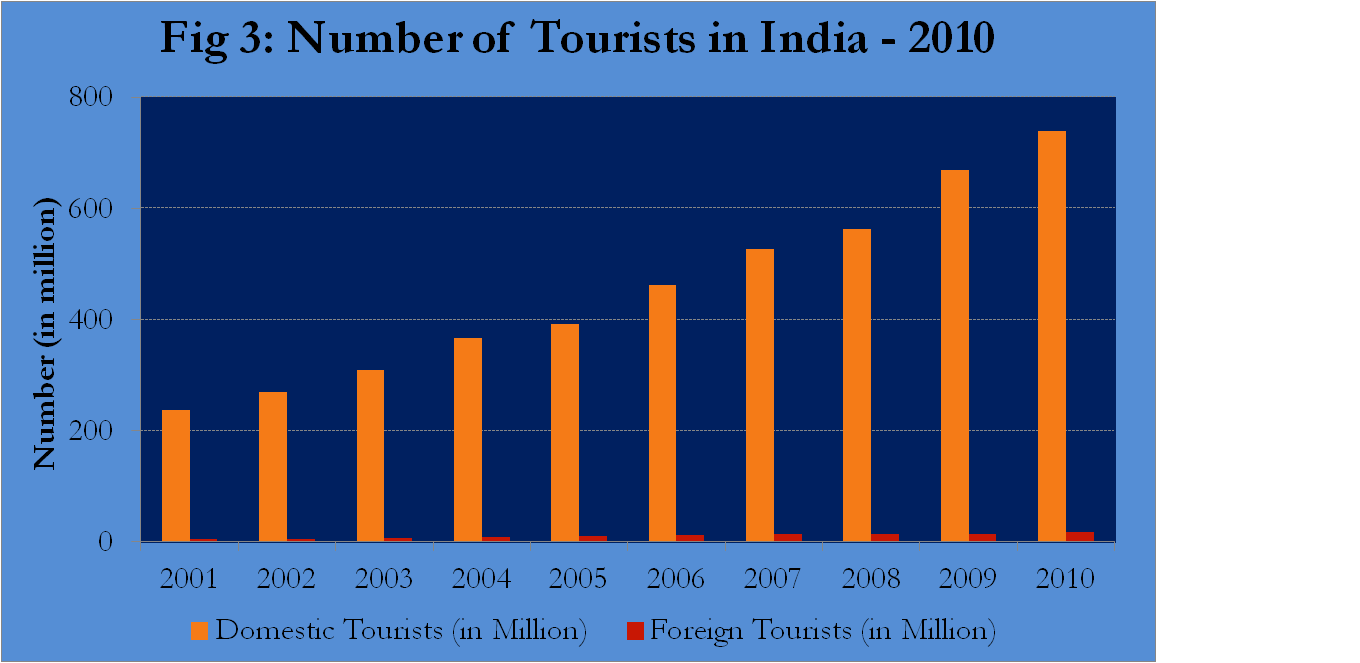
However, Fig 3 shows the actual contribution of foreign tourists to Indian tourism scenario in terms of number of tourists. Though the domestic tourists have increased substantially lower than foreign tourists, it touches almost 750 million in 2010. (Click on the Fig to view properly)
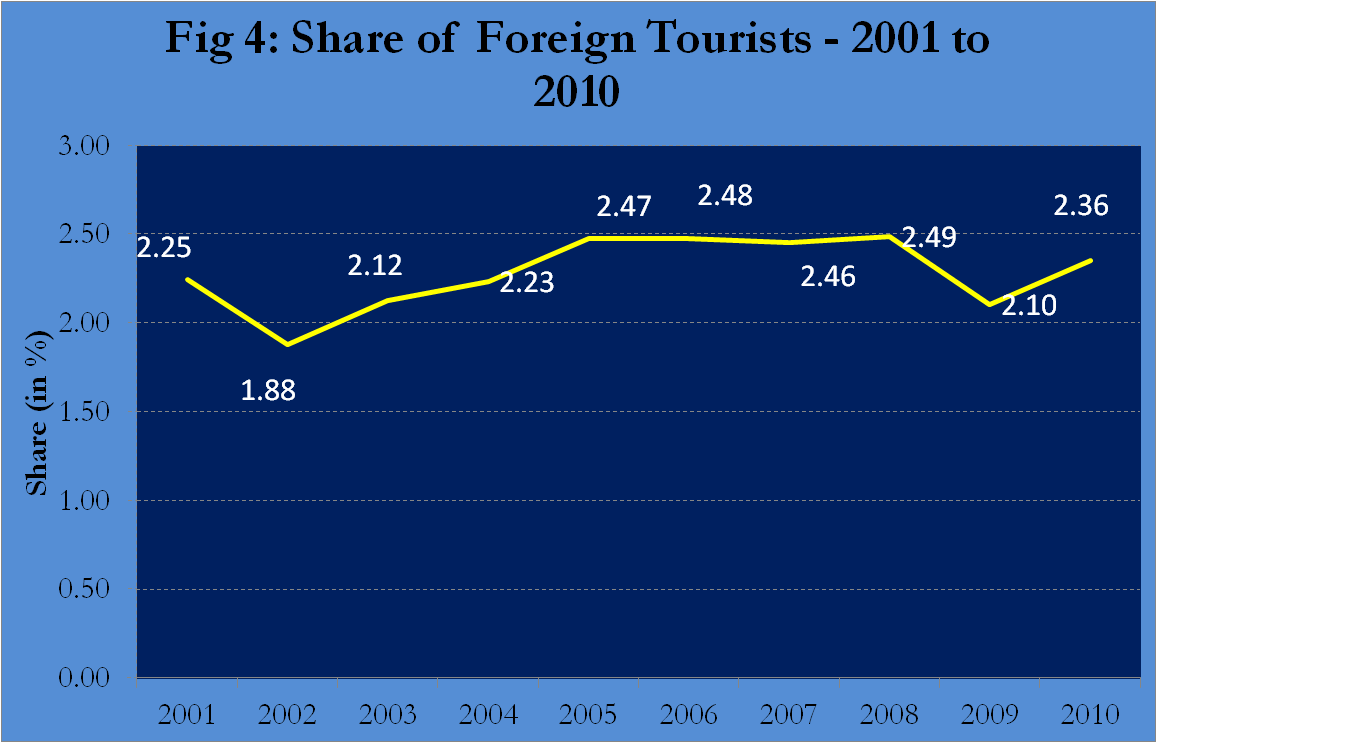
To make the scenario a little more distinct, share of foreign tourist to total tourists is presented in Fig 4. It shows that through out the period the share of foreign tourists remained stable though the absolute number has increased many folds except a couple of exceptional years due to certain externalities such as economic recession. (Click on the Fig to view properly)
This simple analysis suggests something important for Indian tourism industry. The strategy to attract foreign tourists to the country is beyond question. But, we should not neglect the opportunities to promote domestic tourism also. The potential contribution from domestic tourism can change local economy of of several destinations through generating revenue and employment. However, it is also important that the domestic tourists are made aware of preliminary principles of sustainable tourism. This would lead to benefits for a long term basis instead of short term one.


This article is written by : Dripto Mukhopadhyay

Crosswoods holidays 2011 ------------------------------------------------------------------------Thank You---Post Your Comments Below---------------------------

Wednesday, 7 March 2012

India to be promoted as year-round destination at ITB Berlin

Union Tourism Minister, Subodh Kant Sahai to inaugurate India pavilion which will witness participation of 50 companies and 11 State Tourism Boards

Subodh Kant Sahai, Union Minister for Tourism – Government of India will inaugurate the India Pavilion at the International Tourism Bourse (ITB), scheduled from March 7 to 11, 2012 in Berlin, Germany. The Pavilion will showcase a wide array of the country’s tourism products and destinations at ITB. It’s main focus will be to promote India as a year-round destination among global inbound source markets. The total area of the India Pavilion at ITB this year is 871 square metres. 11 state tourism boards and a total of 50 participants comprising tour operators, destination management companies, hotels and resort companies will showcase their tourism products and destinations at the Pavilion along with India Tourism.


The state tourism boards of Maharashtra, Tamil Nadu, Himachal Pradesh, Assam, Andaman & Nicobar Islands, Andhra Pradesh, Jammu & Kashmir and Dadra & Nagar Haveli, etc., will be participating at the event. This information was provided by an official from the Indian Ministry of Tourism. Along with Sahai, Devesh Chaturvedi, Additional Director General (Tourism) - Ministry of Tourism, Government of India and distinguished delegates from India will also be present at the inauguration. In addition, India Tourism will also organise an Incredible India evening, breakfast meetings and happy hours during ITB Berlin


Speaking about ITB Berlin and his expectations for India, Subhash Goyal (Chairman- Stic Travels), President - Indian Association of Tour Operators, said that ITB Berlin is the most attended and most efficiently organised travel and tourism trade show in the world. “ITB gives all participants an opportunity to interact with lots of exhibitors on a one-to-one basis. As tour operators, we always like to meet buyers, suppliers and exhibitors personally so that we can understand the products better. It provides good firsthand knowledge about various destinations, various new markets and exposure to new ideas specifically from experts in the tourism arena. Such direct interactions lead to increasing our knowledge on potential markets for India and business contracts are also signed. Our expectations are very high and all our participants are getting ready with varied holiday packages to meet the changing interest and changing profile of tourists.”


Agreeing, Peter J. Leitgeb, President and CEO, The Claridges Hotels & Resorts, said that ITB Berlin is certainly one the biggest travel tourism fairs organised across the globe. “It provides a strong platform for brand exposure on a really wide international level, helping the brand make its mark and gain recognition in the industry. It offers a great networking channel and helps promote India as a Destination very strongly. Above all, ITB Berlin is of prime importance as it helps all travel trade-related professionals to generate business.”


The travel industry feels that the Ministry needs to promote India very effectively in order to make the most of the trade fair as the tourism policy in effect sets the tone for marketing and promotions through the year. “The Ministry plays a very important role at global trade fairs like ITB and sets the trend and tone for marketing India and attracting tourists to the country. Therefore, our expectations are linked to the tourism policy at the concerned time, which should promote all aspects of the country and endeavour to make India an all-year destination. Hence, to be effective and cover pan-India, it has to work with the state tourism boards and bring out the best in what the country has to offer. This needs to be showcased at ITB - highlighting new trends and products with tourist-friendly policies. Expectations can come from growth in the new source markets and niche tourism products promoted at ITB accordingly,” said Arjun Sharma – Managing Director, Le Passage to India.


Sharma also opined that the role of tour operators is limited and it is up to the Tourism Ministry to project Brand India properly. He said, “To increase expectations of getting more tourists, we need to address issues relating to pricing of the tourism products, which is high due to the recession in the source markets when compared to other destinations. If the Tourism Ministry is proactive and innovative in its approach, is constantly working to find new ways to enhance business for India and is working on developing new tourism circuits and introducing new niche products for India, we can be positive on the outcome of ITB. We hope that budgets for Europe are used well to get the maximum exposure from such a platform by studying what others are doing at ITB and what we need to do at our end to tap the potential and be competitive. Our role is limited as tour operators; the bigger picture at ITB has to be projected by the Ministry for development of brand India.”


Rajeev Kohli, Joint Managing Director - Creative Travel said that ITB is one of the leading shows in the world and has always been a strong venue for networking with old and new clients and for enhancing business objectives. “Creative has been going to ITB for over 25 years and we are always delighted to go back. We expect to do good business and make some new contacts this year”.


“ITB is already playing an incredible role in the global tourism business scenario. It is the responsibility of the participant countries and sellers to be more innovative and active to make the whole show outstanding. ITB always provides opportunities for any destination or tourism stakeholder to present themselves in the most prominent manner. My expectation out of ITB would be that India as a participant, and especially Kerala, my own state, who are already actively participating in the trade fair, would again take part in this year’s event and derive benefits out of it,” said EM Najeeb, Chairman & Managing Director - Airtravel Enterprises Group of Companies.

Source: travelbizmonitor.com

Crosswoods holidays 2011 (www.crosswoods.in)
----------------------------Thank You---Post Your Comments Below---------------------------

Monday, 27 February 2012

Corporate travel to grow 10-15% this year

Undeterred by the global slowdown, Indian Inc is spending on corporate travel, pushing up the outbound market for MICE (meetings, incentives, conventions and exhibitions). The Indian outbound MICE market is estimated to be around $550-600 million and is expected to increase by 10%-15% this year.

About 1.5-1.8 million passengers travelled outbound for meetings and conventions. Pharmaceuticals, cement FMCG, IT and financial services are the major industries contributing to the sector.

Forecasting a strong growth, Travelport COO Heena Akhtar said the industry was expected to grow by 10-15%. "The slowdown meant that regular companies cut down on their corporate travel last year. But this year, we are expecting a revival in incentivized travel and meetings by corporates,'' she said.

According to a study on India's MICE market by Synovate Business Consulting, the most popular destinations in Europe in the last two years included Germany with 73% opting for the destination followed by UK (52%), France (51%) and Switzerland (45%).

Speaking on the interest in Germany, German National Tourist Office director (sales and marketing) Romit Theophilus said, "Indians have a high spending capacity and we are expecting a 10-15% growth in business tourist arrivals this year.''

GNTO has seen a sustained growth of 20% year-on-year from Indian travelers with the number of visitor overnights growing by 26.2% in 2010 as compared to January-December 2009.

Lower hotel rates and carrier options in Europe supported by infrastructure, the vast number of businesses placed in European countries and services have popularized Germany as a business travel destination according to the report.

Other destinations too have seen significant growth from Indian tourist arrivals under the MICE segment including Hong Kong by 12%, Malaysia (15%), Thailand (30%) and Czech Republic by 40%.

The study also pointed out that top management accounted for 70% of the meetings and 50% of the conferences in MICE trips. Incentive trips were mostly conducted for executives and middle management accounting for 30% of the MICE trips.

Among the factors considered important for corporate travel are nature tourism, food and dining and cultural tourism, the report said.

Incidentally, countries like Austria, Indonesia, Turkey and Bhutan have offered discounted offers to woo large size groups while new entrants like Czech Republic, Spain and South Africa are pitching for an India-centric policy to tap the Indian MICE segment.
Courtesy : Times of India

Crosswoods holidays 2011

Monday, 20 February 2012

Orissa wins best emerging tourist destination award

The rich tourism potential of Odisha has won the state a prestigious award. A travel magazine, "Travel + Leisure India and South Asia", basing on its annual reader survey, rated Odisha has the best emerging tourist destination in the country.

General manager, Orissa tourism development corporation (OTDC), Manoranjan Pattnaik received the award at a function in new Delhi recently.

"Parameters like upward trend in arrival of tourists, both foreign and domestic, infrastructure development, identification of new tourist circuits and vibrant marketing helped us win the award," Pattnaik said.

Tourism secretary Ashok Tripathy said the department had drawn national and international attention by blending tourism with culture. "The award is a big fillip for us," he added.

Sources said Turkey got the best emerging tourist destination in the world whereas Goa was adjudged as the best honeymoon and wedding destination in the country.

Meanwhile, the OTDC is all set to sign an agreement with its Delhi counterpart to strengthen reciprocal promotion of tourism and travel-related commercial activities between the two regions.

"I had a preliminary discussion with the Delhi tourism officials on the matter. We are hopeful of signing an MoU very soon," Pattnaik said.

The OTDC had recently joined hands with the Goa tourism development corporation to boost tourism links between the two places. "Plans are afoot to collaborate with other states like Kerala, Rajasthan and Uttar Pradesh," the OTDC general manager said.

Source: Times of India
Crosswoods holidays 2011

Thursday, 16 February 2012

Is Medical Tourism Recession-Proof? Study Says Yes!!

Medical tourism is not only one of the fastest-growing segments of the travel industry, it is especially resilient during economic downturns, according to a new study on tourism niches.

While global economic conditions have a profound impact on such areas as cruise, business and incentive travel, medical tourism is among sectors that “continue to grow at a steady rate despite the financial crisis,” stated Specialty Tourism: A Global Outlook, a report issued by Global Industry Analysts, a market research firm.

Part of a larger trend
The report identifies specialty travel in general as having a major impact on overall tourism growth. It hails the “targeted approach” as sparking the creation of new tour products and consumer interest.

“Specialty tourism has also responded well to growing consumer interest in educational, health and active tours,” noted the report, which also cited adventure travel as a growing niche that is relatively resistant to economic trends.

Enormous potential for medical tourism
The report forecasts that by 2015 the medical tourism industry will generate revenues of nearly $168 billion.

An aging global population, rising life expectancy rates, and growing awareness about healthcare, diseases, and available therapies are contributing to demand for quality healthcare services, according to the report.

Together with growing demand for quality healthcare services at affordable costs, these forces are expected to drive the growth of medical tourism.

Huge savings for consumers

The report also cited the high cost of treatments in some regions as a major factor in driving patients to seek care in foreign countries.

Several surgical procedures performed in countries such as Thailand, India, or South Africa involve about one-tenth of the cost for such procedures in North America or Western Europe, it noted.

“For instance, a knee replacement surgery in Thailand is at least four times lesser than the cost incurred in the U.S. Likewise, dental, cosmetic and eye surgeries in Western countries cost three times as much as in Asian countries,” the report stated.

Lack of sufficient insurance coverage and the availability of high-quality and advanced services in destination countries were also cited as driving patients to overseas markets.

Most favored nations
When it comes to medical tourism destinations, the report singled out Asia and South America as regions with the most potential, “due to their low-cost healthcare facilities and availability of world-class healthcare service providers.”

“Several developing countries have emerged as favored destinations for patients seeking low cost medical services,” the report stated. “These countries are benefiting from the rapid expansion of medical infrastructure and facilities, better room care, less waiting time, higher success rates, and above all affordable costs.”

Among important medical tourism markets cited in the report are: Panama, Brazil, Costa Rica, Thailand, India, Malaysia and Singapore.

Emerging destinations

South Africa, Argentina, Cuba, Jamaica, Hungary, Latvia, Estonia, Dubai and Jordan are as emerging as destinations for medical tourism, the report said.

Certain destinations are favored by consumers for certain procedures or types of procedures. For instance, Costa Rica and Argentina are emerging as preferred destinations for American patients seeking high-quality plastic surgery. Europeans prefer South Africa for plastic surgery.

Hungary is favored for dental procedures and cosmetic surgeries among West Europeans and Americans.

Eastern Europe countries, particularly Poland, Hungary, and Czech Republic are emerging as major private medical care tourism destinations for westerners.

Challenges for medical tourism
The report also noted several challenges facing the medical tourism industry. Among them is the fact that a number of developing countries aiming to be recognized as high-quality healthcare destinations are often branded as low-cost destinations.

“Most of the developing countries are competing to grab a share of the pie rather than cooperating with each other for designing, developing and facilitating the global medical tourism industry,” the report said.

Risk mitigation was also identified as a challenge, as patients may have no course of retribution in cases of a botched medical procedure.

“In addition, security concerns of medical tourists in case of natural or political disasters need to be addressed in order to drive growth of the global medical tourism market,” the report stated.

Resources
Travelers sellers can learn more about medical tourism, including strategies for reaching the market, by attending the Well-Being Travel Conference 2012, June 19-21 at the Phoenician resort in Scottsdale, Ariz. The groundbreaking educational event is co-sponsored by Well-Being Travel and Travel Market Report. To register or learn more, visit www.well-beingtravelconference.com.

Courtesy : treavelmarketreport.com


Crosswoods holidays 2011

Monday, 13 February 2012

Indian Hospitality industry to grow at 15 per cent!!!

Slowdown in economic growth notwithstanding, the hospitality industry is confident of 13-15 per cent annual growth over the next five years, banking upon surge in business travel and expansion in number of hotels in the country.

Hotel majors such as ITC, Starwood and Berggruen are out to woo business tourists by betting big on the low-to-mid segments, a category which is expected to grow higher than the industry rate. The growth in the Indian hospitality sector will outpace that in the overall global hospitality sector, according to industry leaders and analysts.

ITC plans to double its room count in next seven years, said SC Sekhar, senior executive vice-president, hotel division, ITC. “Our country’s growth projection is 6.9 per cent for 2011-12, so what if it is not 8 per cent. We are still far ahead of many other destinations,” Sekhar said at the state tourism seminar on Saturday.

ITC that started hotel business in 1975 operates and owns over 100 hotels in India in 18 cities and will open at least three hotels in next few years. Sekhar added that ITC does not plan to foray overseas as it plans to meet demand for hospitality services in the country.

Same is the story of Mumbai-based Berggruen Hotels that plan to cash in on growing demand by opening 10 more hotels in next three years, the chain’s managing director and CEO, Sanjay Sethi said. The company at present operates around 30 hotels.

The story is no different with US-brand Starwood that is gearing up to operate about 100 hotels in India through management contracts. “We are currently operating 33 hotels in the country and the number will increase to 50 by 2015. By then, another 50 hotels projects will be on course,” said Dilip Puri, managing director (India) and regional vice-president (South Asia), Starwood Asia Pacific Hotels and Resorts.

The Lemon Tree Hotel Company that owns 18 hotels in mid-market segment also announced that it aims to be the second largest asset owner in the country in hospitality sector if one were to go by Rahul Pandit, president and chief operating officer, The Lemon Tree Hotel Company. At present, it claims to be fourth largest asset owner in hospitality business in the country.

“Globally, the penetration rate of hotel rooms is 28 per 1,000 people. In India, it is much lower at 1 per 1,000 people. There is huge room to grow in mid-scale segment. In the next couple of years, we plan to go public with an IPO (initial public offering),” Pandit said.

Other global hotel chains such as Marriot and Carlson also plan to expand in India. Marriot plans to introduce its mid-segment Fairfield brand the year end while Carlson will add 19 more hotels in the country, taking its total count to 50.

“About 13 to 15 per cent growth is expected in hospitality sector over long term in India. The growth in the mid-segment will be higher and ultra-premium segment will be smaller. However, the realisation of sustainable growth depends on expanding infrastructure and better managing of talent,” said Timmy S Kandhari, leader (hospitality and leisure practice), PwC India.

The global consultancy firm also released a hospitality report on Saturday based on interactions with 20 top CEOs of the hospitality industry in India, which pointed out that revenues from business travellers will grow significantly over next few years followed by meeting incentive conference and exhibition segment (MICE) segment and lastly from leisure travelers.

Source : mydigitalfc.comCrosswoods holidays 2011

Kenya take bold steps to attract tourists

Kenya take bold steps to attract tourists, who already keen to visit excellent sites in Kenya other than the traditional Coast and Maasai Mara National Game Reserve are welcome to visit Baringo County and Kisumu, both emerging as two of the leading tourist destinations.

Players in the tourism industry within the western tourism circuit are re-packaging their services and products in a bid to maximise benefits from an anticipated influx of visitors to the region following the launch of the Kisumu International Airport.

Hot on the heels of the airport launch by President Mwai Kibaki and Prime Minister Raila Odinga last week, the Lake Victoria Tourism Association (LVTA) on Tuesday announced that tourism partners from the region had decided to shift away from tradition and come up with new products that will give the circuit a unique identity.

Association secretary general Norbert Otieno said although the region is rich in cultural diversity and captivating sites, little had been done over the years to package it to visitors.

“Most products here that can boost revenue from tourism are drawn from the culture of the people and the natural sites. Now we want to introduce new kinds of products to market them,” he said.

A range of activities are set to kick off from this weekend with a bush dinner party to be held at the Kisumu Impala Park on 11th.

According to Mr Otieno, the event will package several activities into one in order to give guests, both local and foreign, a wholesome tourism experience.

“The cultural aspects will be brought out through a variety of traditional meals and the visitors will have had a chance to take a tour of the park earlier in the day,” he said.

Other events that have been lined up to take place within the year include a gala night, a cultural night and a beauty contest.

However, the region still has a big problem to deal with: accommodation facilities are still wanting.

Kisumu Hotel Managers Association chairman Robinson Anyal said although there were more expansions of hotels and lodges going on, investors still had to do more to beat the challenge.

“There are accommodation facilities coming up currently but we are still encouraging investors to upgrade their hotels and train their staff to enhance quality services,” said Mr Anyal.

Kisumu, which is strategically linked to roads, air, rail and water transport is the main entry point to the rest of the region falling under the Western Tourism Circuit. But it only has a bed capacity of 950 or so.

Kisumu International Airport is also expected to open up the region to the global market, raising its prospects of hosting more visitors.

With around five hotels under construction and expected to be complete by the end of the year, LVTA has projected that the bed capacity could increase to 1,500 this year.

The western tourism circuit covers Nyanza province, Western and parts of the South Rift.

In Baringo County, visitors who wish to spend festive seasons, holidays or corporate team building events and retreats parties can do so at the Lake Bogoria National Game Reserve which is 107 square kilometres.

Crosswoods holidays 2011

Popular Posts

Followers

Pages